Libraries sometimes have a quandary. We like to have standards at our public access terminals to reduce complications in managing these commons. We also have the majority of our use coming in from a distance on a variety of devices including mobile. We can see this from our Google analytics traffic reports. Then again everyone has their favourite device and browser or app either through habit, institutional mandates or a desire to always be on the edge of tech.
So we can have our personal preferences but our professional position HAS to be to support everything and everyone – unlike some of my experiences in the corporate sector where they can mandate a certain configuration (some actually still believe they can avoid BYOD). So make sure you’re checking out trends in your traffic. Test your sites and services for alignment with your community. Are you losing users or at least frustrating them because too much of your virtual services offerings fail in a a particular browser or with mobile?
Internet Explorer still growing as Windows 7 starts its decline
Windows 8’s growth is underwhelming, except among gamers.
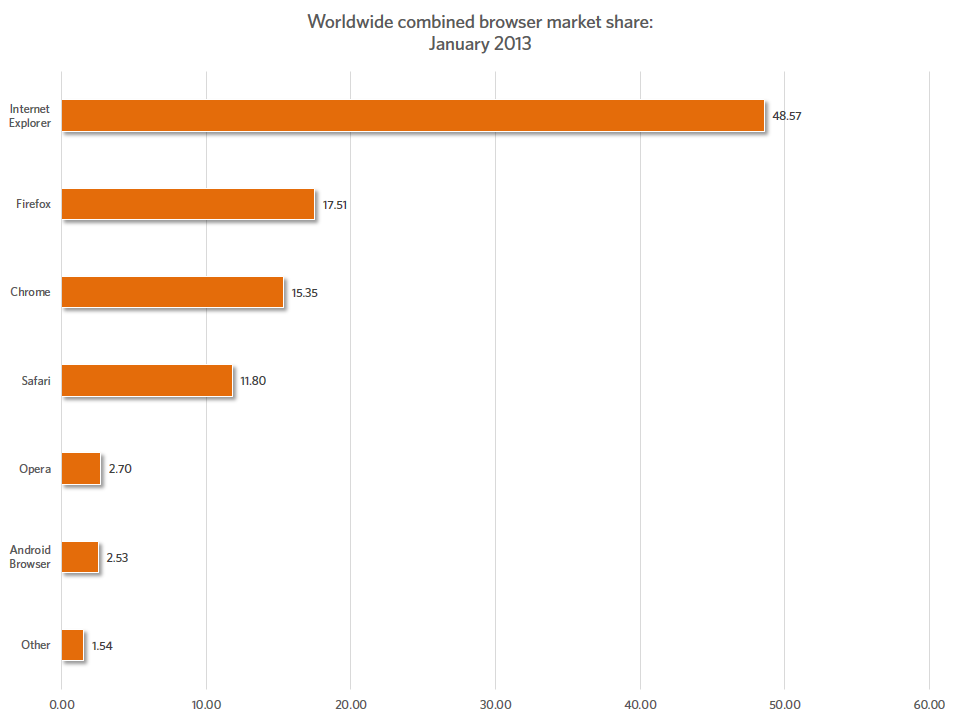
“In the first month of 2013, Internet Explorer’s desktop market share is continuing to slowly climb upwards, with Firefox consolidating its number two spot. There are signs that Windows 7 may have peaked as Windows 8 is slowly picking up users.

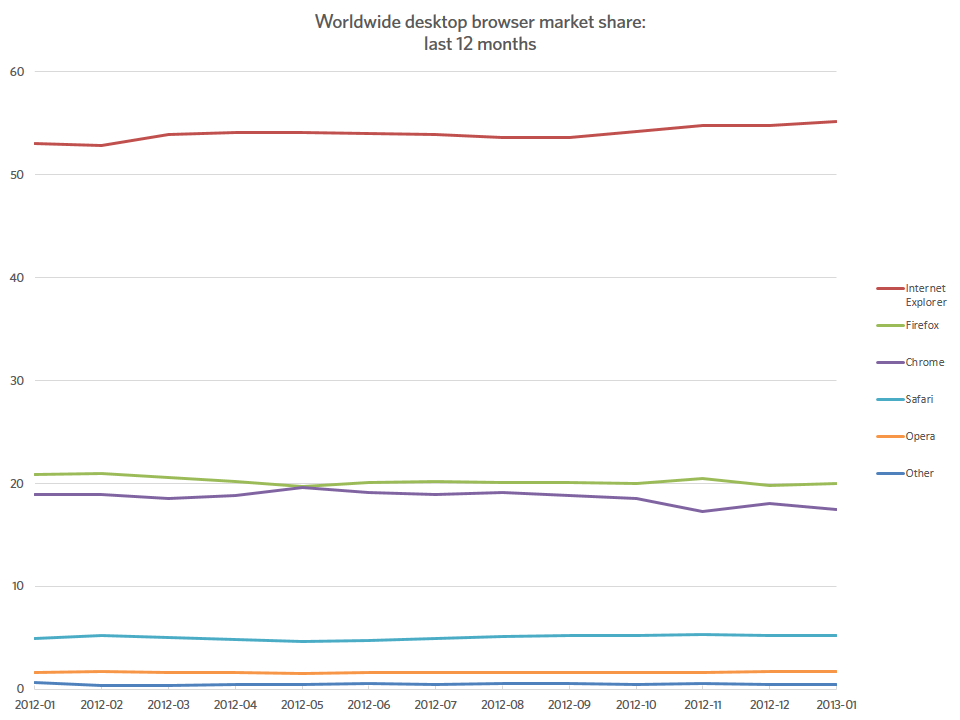
January was a good month for Microsoft’s browser, up 0.37 points to 55.14 percent. Firefox also grew, up 0.12 points to 19.94 percent. Chrome fell, down 0.56 points to 17.48 percent. Safari was unchanged at 5.24 percent, and Opera up a hair, gaining 0.04 points to reach 1.75 percent.
The improvement of Internet Explorer’s position masks a story that’s decidedly mixed for Microsoft. Windows 7 fell for the first time in January, dropping 0.63 points from a high of 45.11 percent to 44.48 percent. Windows 8’s slow growth is continuing, up 0.54 points from 1.72 percent to 2.26 percent. There’s also a small number of tablet users, with 0.08 percent on Windows 8 Touch and a minuscule 0.02 percent on Windows RT Touch.
Taken together, the growth by the Windows 8 family seems to be covering the losses Windows 7 has incurred, but that’s surprisingly weak. With corporations still migrating from Windows XP to Windows 7—a process that should continue even in spite of Windows 8’s release—one would expect Windows 7 and 8 to both be growing.
There are, however, signs that Windows 8 is catching on, at least in some audiences. Valve’s latest hardware survey results are out, with Windows 8 up 1.83 points in January, to a total of 8.76 percent (overwhelmingly favoring the 64-bit version). The Valve hardware survey arguably represents the enthusiast segment of the market; virtually all hardcore gamers are using Steam (though Steam also has plenty of non-hardcore games), but it appears that at least that group is happy to make the switch.
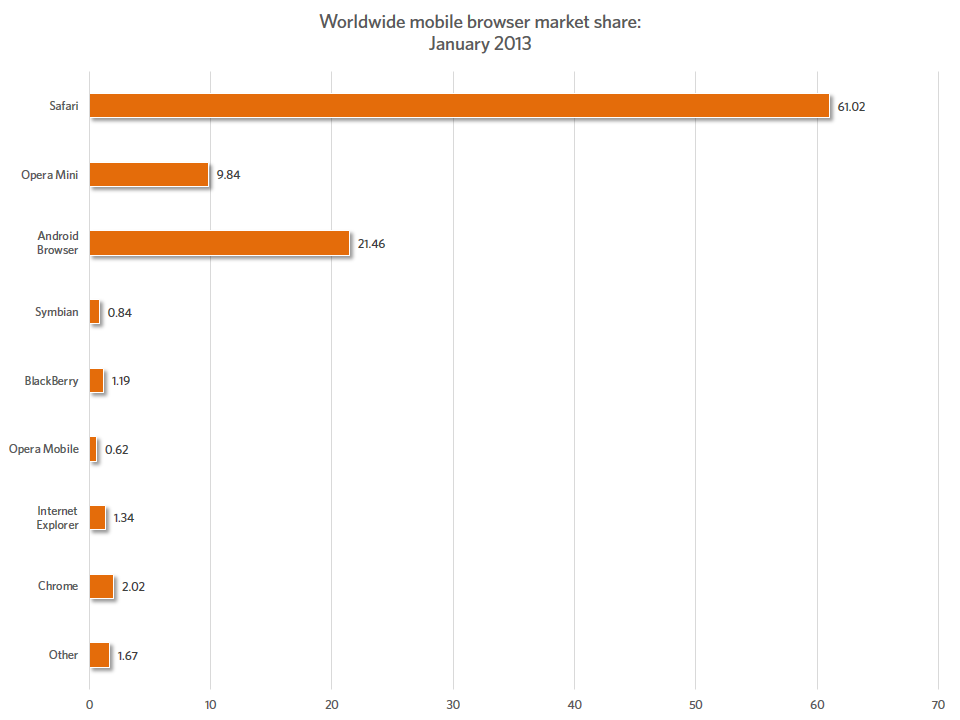
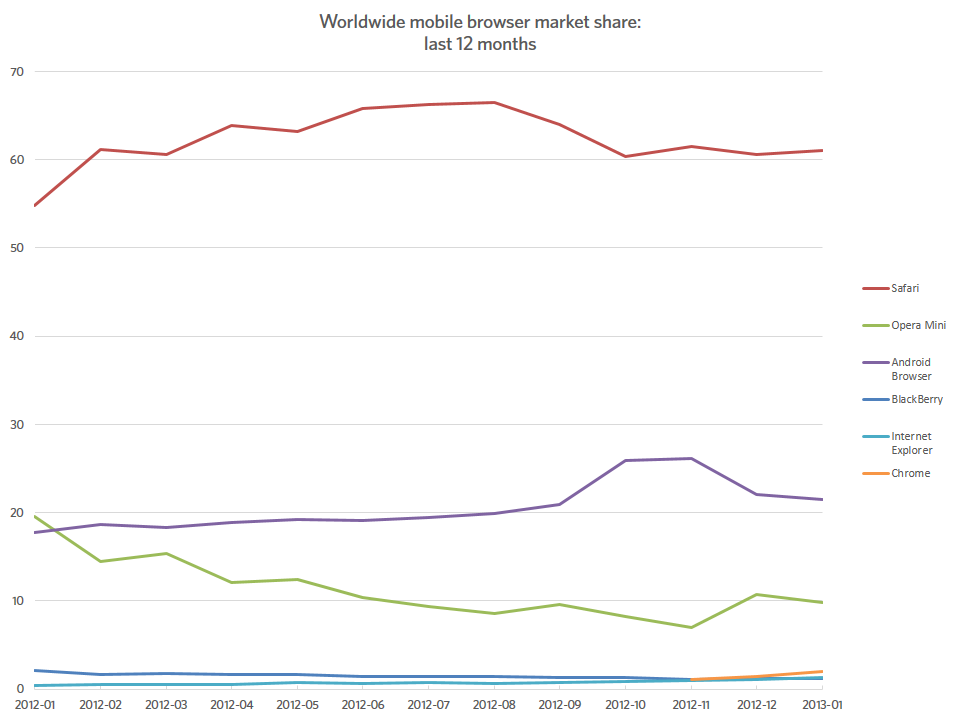
The news in mobile is more unambiguously improved for Microsoft. Unsurprisingly, Safari remains totally dominant, up 0.46 points to 61.02 percent. Android has a firm hold on second place, down 0.64 points to 21.46 percent. The surprise story is Internet Explorer; after languishing below 1 percent for years, it has posted relatively strong gains for the last couple of months, in January picking up 0.18 points for a total of 1.34 percent. Windows 8 may be struggling to win hearts and minds in the tablet space, but Windows Phone seems to have turned a corner.
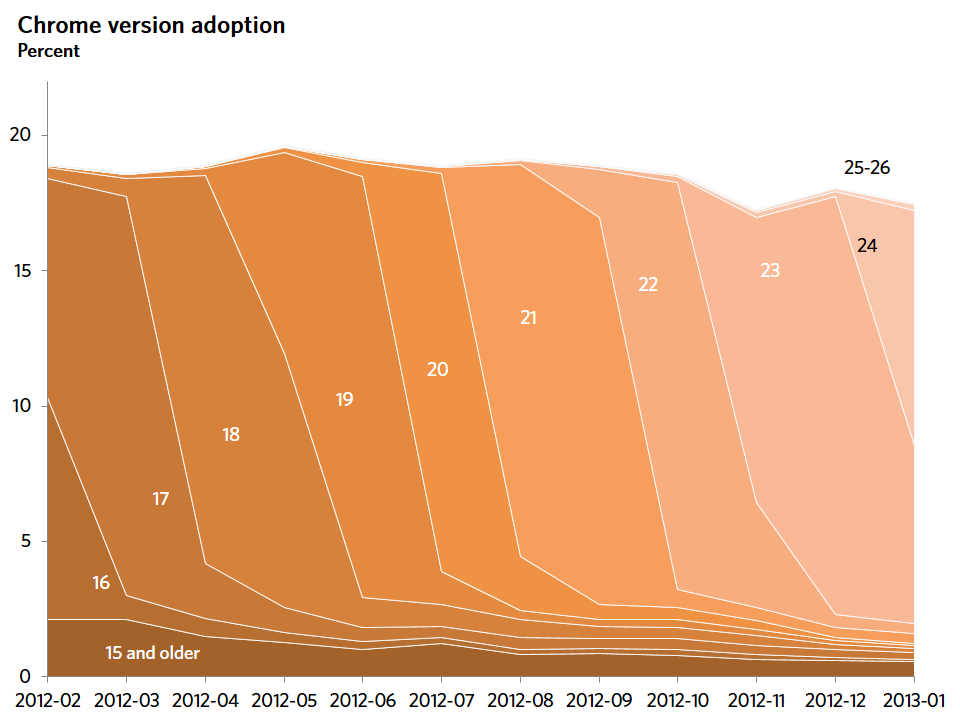


The Chrome and Firefox automatic updaters remain as solid as ever. Over the last year a familiar pattern has emerged: while almost everyone is updated by Chrome’s installer, each new version of Firefox is leaving some users behind, and those users are sticking with their old browser versions for a prolonged period. Why this should be isn’t clear; although the Firefox updater was initially problematic, nowadays it’s pretty solid and effective. The users of the very old versions are susceptible to all manner of security flaws; it is perhaps only their relative obscurity keeping them safe.
Just as January saw Windows 7’s first decline, so too did it see Internet Explorer 9’s first decline. Similarly, just as the Windows 8 gains offset the Windows 7 losses, the Internet Explorer 10 gains are offsetting the Internet Explorer 9 losses. Internet Explorer 10 usage is still less than half of the level of Windows 8 usage, however, indicating that a majority of Windows 8 users simply aren’t interested in Redmond’s browser. The release of Internet Explorer 10 for Windows 7 isn’t too far off; this should see greater uptake of Microsoft’s latest and greatest browser.”
Stephen

3 Responses
Stay in touch with the conversation, subscribe to the RSS feed for comments on this post.
I had my first experience with IE 9. It is awful and I hate it. Microsoft is continuing the pattern it established with the new Office suites of putting all the tasks you most frequently do at least one additional click away, and hiding them in unexpected places. Do they ever do any testing with ‘real people’ (as opposed to Silicon Valley computer nerds)?
Continuing the Discussion
Emily Scherrer liked this on Facebook.
Stephanie L. Gross liked this on Facebook.