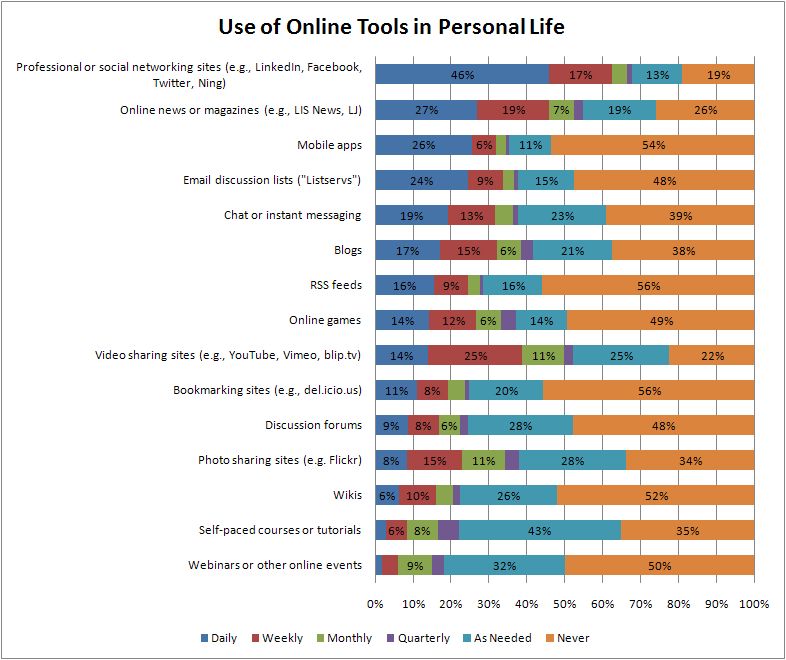
WebJunction is reporting on their second survey of library workers and their usage of online tools:
WebJunction:
Library Staff Report Use of Online Tools (Again)
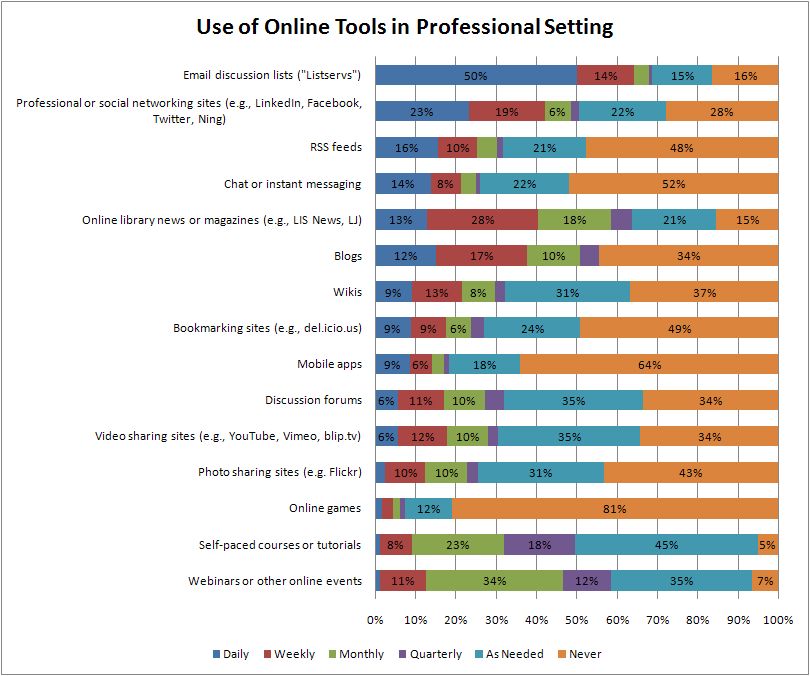
In these are times of dynamic change in our profession, everyone must be investing in professional development (time for than dollars) and learning the opportunities provided by new modes of tech and beyond. Most learning (distance and otherwise) requires usage of the tools covered in ths survey. I’m a little concerned that too many folks don’t use many of these tools at all. How can we scale professional change if people don’t use the tools at our disposal that make learning scaleable?
Stephen

5 Responses
Stay in touch with the conversation, subscribe to the RSS feed for comments on this post.
Teachers and school librarians(Elementary) struggle to find time to learn, use and teach with new technologies. Should the role of the school library/librarian shift to showcasing technology and how to use it. Invite staff/students to bring their PED’s to the library and share, collaborate and learn. Will school libraries get more attention/appreciation – budget allocation this way? Will school boards pay for more Professional Development for their Librarians?
The issue shouldn’t be that they learn to use these tools. The issue never addressed is HOW they should be used. It’s one thing to tell a librarian to start a blog, wiki, or video service. It’s quite another to show that it takes time, effort and proper marketing to make it work for your library.
These should not be seen as quick fixes and panaceas to professional change in libraries. They, like anything else we should be doing, are tools that have to be used properly, and that won’t happen by just saying you have to use them.
Dan:
I’d just suggest that librarians are the ones who should be determining how to use these tools. Exactly how can someone who doesn’t know how to use the newer tools (and most of these aren’t very new anymore) determine how they might fit into a library’s strategy? And how can we get staff to adopt new methodologies and technologies if so many have little or no understanding of the tools? I think that librarians are professionals and that professionals invest time in learning what’s new. The good ones don’t wait to be spoonfed by management. If everyone waited until all the i’s were dotted and t’s crossed we never get anywhere. Like I always say, studying things to death never gets you anywhere by dead. I’d love to see more grassroots innovation and imagination and not more planning and waiting until the ‘proper’ use is determined by someone else .
SA
Stephen,
I think you misunderstood my post and in a fairly dismissive way. I wasn’t saying librarians should be shown how to use these tools by management or that there’s a “proper” use of them. I was saying that we see many librarians saying how we need to use these tools, but you see very little end results to show as success stories. And the ones that are shown don’t often go into what worked and what didn’t along the way. Meredith Farkas is a great example of talking about how projects initially didn’t get used as planned and how that changed the focus of the project.
There is no quick fix. The successful library projects I’ve seen (and the ones in which I’ve participated) have moments of incubation, collaboration and tweaking the misses and near hits you have. It is a grassroots movement and it takes imagination, yes. But it is not, as you seem to suggest, “download this toll and you’re done!”
People need to see what didn’t work and how it was handled. They need to see how you might have moved beyond the library box and worked with others who had similar ideas. About how you asked your users what they need. And, yes about how you dealt with the management.
Asking to see how someone went through a process is not holding someone down. It’s making them share, And that’s important for librarians who may not really know what to do with these devices/software and need to see a fresh idea to spark theirs.
Dan:
Sorry you thought I was being dismissive. It is difficult to communicate effectively and quickly on a blog comment but I assure you that wasn’t my intent. I’m on vacation this month so maybe I just responded too quickly. It’s better than responding in 140 character tweets though. 😉
I see so many great instances of libraries using these tools effectively and well and learning by doing. I tend to forget that most folks don’t get to go to the 100-150 library conferences a year that I do. I see so many great working social sites and strategies. I’ve also been involved in many periodical and conference advisory boards for many years. When we’re planning the core conferences like Internet Librarian and Computers in Libraries we make a huge effort to make sure that we put the voice of experience on the program so folks like Meredith, David Lee King, Joe Murphy and more, who are actually trying the new things, report on what they’re doing and seeing. And yes I do encourage people to blog and write about their experiences. In the early days the hundreds of articles on the library 2.0 label/meme created quite the backlash and loads of negative feedback for many writing about their experiences. Some have shied away from writing about what they’re doing due to thus negativity about the social tools which can become quite personal. I know of a few who have quit blogging altogether. I’ll still keep encouraging folks who are doing the real work to show their stuff. Too much of what library folk are doing is kept under a basket.
Cheers,
Stephen