Ereader User Increases Slow
More than one in 10 book readers have gone digital-only
http://www.emarketer.com/Article.aspx?R=1009576
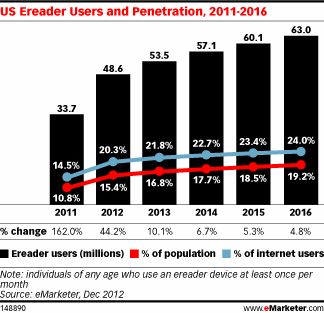 The fastest growth in ereader users last year was among blacks, among whom user numbers increased 81%. Uptake by Asians also rose faster than average. Both groups will continue to post above-average growth rates in users throughout the forecast period.
The bulk of ereader users are older adults, with 57.2% of the total ages 45 and up last year, and that will only change slightly in coming years. While user numbers will grow fastest in 2013 among children under 12, by 2014 older adults will again be the leading growth area for ereaders. By 2016, 60.1% of ereader users will be 45 and up.
November research from the Pew Internet & American Life Project found that ebook ownership reached 19% of consumers ages 16 and up. This is slightly higher than eMarketer’s penetration figure of 15.4%, but eMarketer includes users of all ages in its estimate and young children are the least likely group to use an ereader.
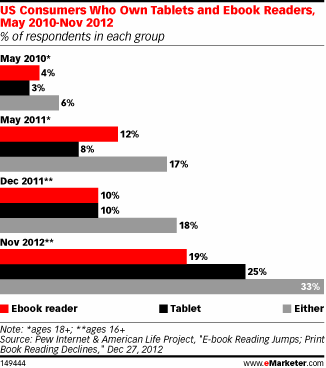
Pew found that among consumers of all ages who reported reading a book in the past year, 30% had read at least one ebook during that period. That compared with 89% who said they had read a printed book—leaving around 11% of book readers who seem to have gone digital-only in their reading.”
Read more at http://www.emarketer.com/Article.aspx?R=1009576#EEOLMq5tDscrsEaZ.99
Stephen

10 Responses
Stay in touch with the conversation, subscribe to the RSS feed for comments on this post.
Rich: I agree. It usually takes a little time to help people make the separation between e-paper based, refected light readers and tablets, app based backlit reader tablets. It doesn’t help that the tablet apps are called the same names (Kindle, Kobo, Nook, etc.).This is true even for pros like librarians. I still believe that our human biology finds greater comfort factors in e-paper verusus having mild light shined into your eyes and changing the dynamics of our brain chemistry. That said, I prefer imaginative reading (fiction) on print or e-paper and action based reading (business-related, news, e-mail, social media, etc.) on a plasma screen. Therefore I choose the device and haven’t forced myself on to one, single form factor. There are too many variables to limit to just one – desktop, laptop, e-reader, tablet, smartphone, whatever. So I just pick whatever works and is at hand. I think that we’re in a hybrid digital device ecosystem for many years yet.
Continuing the Discussion
RT @sabram: Ereader User Increases Slow: More than one in 10 book readers have gone digital-only: Ereader Use… http://t.co/crhpKoOu
RT @sabram: Ereader User Increases Slow: More than one in 10 book readers have gone digital-only: Ereader Use… http://t.co/crhpKoOu
Silvia Franchini liked this on Facebook.
Stephen, I wonder how careful these surveys are distinguishing among tablets versus ultrabooks versus so-called e-readers? I use an HP Ultrabook as well as a Kindle Fire HD. My primary uses are not reading books on these devices, though I do use them for same.
I spent a year using an iPad as my only computer. (A year in hell, if you want outside the walled garden, by the way.)
One person, multiple devices, multiple uses.
I agree. It usually takes a little time to help people make the separation between e-paper based, refected light readers and tablets, app based backlit reader tablets. It doesn’t help that the tablet apps are called the same names (Kindle, Kobo, Nook, etc.).This is true even for pros like librarians. I still believe that our human biology finds greater comfort factors in e-paper verusus having mild light shined into your eyes and changing the dynamics of our brain chemistry. That said, I prefer imaginative reading (fiction) on print or e-paper and action based reading (business-related, news, e-mail, social media, etc.) on a plasma screen. Therefore I choose the device and haven’t forced myself on to one, single form factor. There are too many variables to limit to just one – desktop, laptop, e-reader, tablet, smartphone, whatever. So I just pick whatever works and is at hand. I think that we’re in a hybrid digital device ecosystem for many years yet.
Jeffie Nicholson liked this on Facebook.
Marianne E. Giltrud liked this on Facebook.
Jim Bennett liked this on Facebook.
Karen Rupps Hildebrandt liked this on Facebook.