I Love Strategic Retreats and I Hate Strategic Retreats: How to make them work.
I have led or helped to organize teams to plan strategic retreats to help move organizations forward.
I’ve done this for the for-profit sector, associations, and the public benefit sector. I use the phrase ‘public benefit sector’ or ‘community benefit sector’ interchangeably. Our particular sector can benefit from defining itself by what it IS and not by what it is NOT. We are NOT non-profit and we can measure ourselves very well using economic and social return in investment models, but that’s another editorial.
However, we must behave in a business-like fashion while remaining socially driven organizations. We are not businesses. I’ve worked in both sectors and we’re not for-profit businesses. Our organizations exist to provide long term public, social, and community benefit. We are not focused on short term quarterly and annual revenue goals and targets. Hence, we invest dollars in achieving longer term economic and social ROI.
Here’s a useful two column explanation:
| Differences in the Private and Public Sector Approaches to Development | ||
|
Private Sector |
Public Sector |
|
|
|
|
Here’s an approach to strategic execution:
8 Elements of a Well-Launched Task
- An Idea
- Clarify the Situation
- Convert the Idea to a Statement of Work
- Clarify what the task is Not
- State the Expected Results, key milestones and major deliverables
- Select People needed to complete the task
- Allocate Resources to do the job well
- Specify how Success will be measured, compensated and sustained over time
We must focus on the stories that show our impact on society and the value-laden activities we DO.
That said, we must collaborate, cooperate, and think beyond our organization’s borders to be strategic.
I was influenced by this thought:
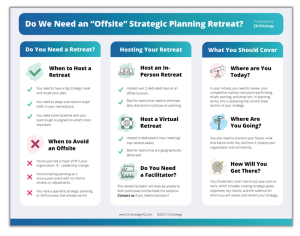
An organizational retreat is a work event where employees leave the office and meet up somewhere new to regroup, recharge, and discuss what’s happening in their sector and enterprise. There are many different types of retreats, including:
- Team Building Retreats – Getting out of the office can be a great opportunity for building stronger employee relationships. These types of retreats usually have one main goal: to help everyone get to know each other better. This is especially important in the post-pandemic environment where many relationships and organizational culture have been disrupted.
- Organizational Retreats – A business retreat is similar to a team building retreat, but usually with more of a focus on developing and sharing the vision, practicing new skills, and making sure teams are aligned.
- Executive, Leadership, and Management Retreats – While most retreats include everyone on the team, executive retreats are reserved for just the leadership team. The focus here is on strategic planning and high-level priorities discussions. Secondarily, this can be a critical initiative if there has been large turnover on the team.
Why we retreat
With major dynamic changes taking place and the need to develop post-pandemic strategies, retreats, in today’s world are now more important than ever. So, why do we retreat?
- Staying connected as we scale
- The sharing of knowledge and ideas
- A culture of collaboration
- Work life harmony
- The return on investment
The pros are:
- Pro 1 – Improved loyalty and retention
- Pro 2 – Team bonding
- Pro 3 – Deepened corporate culture
The cons are:
- Con 1 – Destination meetings are expensive
- Con 2 – Locations change the meeting dynamic
- Con 3 – Retreats take people away from family
- Con 4 – The challenge of pleasing everyone
The Benefits of a Retreat for Your Organization
- Attract and Retain Talent
- Initiate Team Building and Training
- Set New Organization-Wide Goals
- Reflect and Celebrate the Year Prior
- Open Dialogues Between Departments
- Strategize and Plan for the Year Ahead
- Set Goals for Your Retreat
Some common goals for company retreats include:
-
- Celebrating last year’s achievements
- Creating trust between colleagues
- Building your workplace culture
- Strategizing for the year ahead
- Poll Your Colleagues
- Create a Budget
- Find the Right Venue: Remote vs. Urban Settings or Nearby vs. Far Locations
- Choose the Right Time
- Fine Tune Logistics
The 20/30/50 rule for remote team retreats


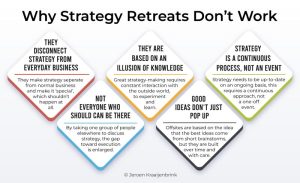
8 Reasons Firm Retreats Don’t Work
https://www.linkedin.com/pulse/8-reasons-firm-retreats-dont-work-sue-ella-prodonovich/
1. EVERYONE HATES EACH OTHER
2. THE BIG KAHUNAS DON’T TURN UP
3. THERE’S NO COHERENT AGENDA
4. NO ONE READS BEFOREHAND
5. YOU DON’T CUT ANYONE SLACK
6. THE WRONG PEOPLE GET INVITED
7. THE ELEPHANT(S) IN THE ROOM GETS IGNORED
8. PEOPLE BEHAVE BADLY
The CEO’s Guide to Strategic Planning Retreats That Get Results: PART 1
The CEO’s Guide to Strategic Planning Retreats That Get Results: PART 1
Here are seven things to do before your retreat to put your organization on the path to success:
1. Decide if you want to create a team strategic plan
2. Conduct market and team research
3. Pick a date
4. Determine whom to invite
5. Pick a location
6. Plan your agenda
7. Hire a facilitator
The CEO’s Guide to Strategic Planning Retreats That Get Results: PART 2
https://www.teamworksweb.com/ceos-guide-to-maximizing-time-strategic-planning-retreats/
Here are six things a leader should do during a strategic planning retreat to inspire your team and align them around a shared vision:
1. Listen.
2. Define your “WHY”, “WHAT”, and “HOW”.
3. Move from the macro to the micro and finally, back to purpose.
4. Give all of your team members floor time.
5. Be an example.
6. Have fun.
The CEO’s Guide to Strategic Planning Retreats That Get Results: PART 3
The CEO’s Guide to Strategic Planning Retreats That Get Results: PART 3
Part III: 10 Ways to Maintain Momentum AFTER Your Strategic Retreat
Here are ten things you must do after your annual strategic planning retreat to build on your momentum and ensure your organization’s long-term success:
1. Thank everyone for participating.
2. Share your plan’s highlights with your entire organization.
3. Book next year’s retreat.
4. Debrief your facilitator.
5. Debrief your team members.
6. Review your plan.
7. Recommit to your plan.
8. Share the details with your organization.
9. Make your plan real.
10. Conduct regular follow ups
Everything You Need to Know About Planning the Ultimate Company Retreat
- Introduction to Company Retreats
- 7 Things You Should Do When Planning Your Company Retreat
- How to Balance Your Retreat Agenda with the Right Sessions to Ensure It’s Effective
- Tips and Tricks We’ve Learned from Over a Decade of Planning Retreats at Outback
- Annotated Outback Team Building & Training Sample Retreat Agenda
- Practical Steps You Can Take to Follow-Up on Your Retreat


0 Responses
Stay in touch with the conversation, subscribe to the RSS feed for comments on this post.